From the desk
What the Free Tiers Actually Ship on These Four Platforms
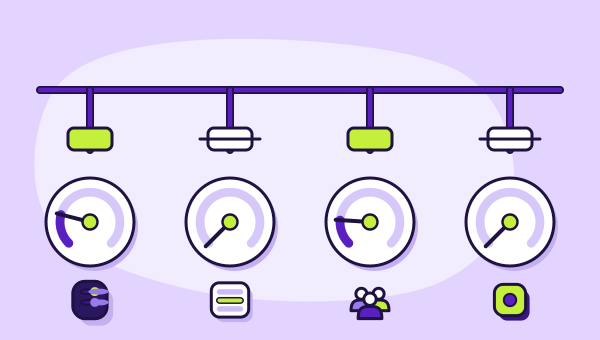
All four publish a free plan and none of them tests the thing you need tested. Here is exactly what each one withholds, and how to run a trial that tells you something.
On this page 6 sections
A free plan is a sales instrument, not a trial, and in this category the distinction is unusually sharp. Every platform on our best no-code app builders list offers one, and every one of them withholds precisely the thing you would need in order to learn anything about the paid product.
That is not an accusation of bad faith. A free tier that let you run a real application would not be a free tier. But it does mean that "I tried it and it seemed fine" is not evidence about the decision you are actually making, and it is worth knowing what each one hides.
Bubble: a development allowance
Bubble's free plan includes 50K workload units a month.
That is a genuine allowance and it is genuinely useful: you can build, you can test, you can click through what you made. What you cannot do is learn what your app consumes under real use, because real use requires real users and real users require a plan that supports them.
The specific gap is that consumption patterns only appear at volume. An inefficient search that costs a trivial amount across your own twenty clicks costs a serious amount across four hundred daily sessions. The free tier will not show you which searches those are, because the numbers are too small to separate from noise.
Use Bubble's free tier to answer "can this platform express my idea" — which it will answer well, and which is a real question. Do not use it to answer "what will this cost", because it structurally cannot. That question is covered in what a Bubble workload unit is.
Glide: zero updates
Glide's classic free plan includes zero updates per month, with up to ten personal users.
This is the starkest example in the category and it is worth being precise about what it means. An update is roughly one changed row. Zero updates means no data can be written through the app by anybody.
You can connect a source, lay out screens, apply filters, and hand somebody a link. They can look. They cannot record anything.
As an evaluation of Glide's interface, that works — and Glide's interface is genuinely good, so it is a fair showcase. As an evaluation of Glide's suitability for your workflow, it tells you nothing at all, because the workflow is the part that costs money and the part that is switched off. The mechanics are in what Glide counts as an update.
Softr: five users, no split
Softr's free plan gives up to three builders and five users, with no distinction between team users and client users.
This is the most honest free tier of the four, in the sense that it lets you build a genuinely working portal for a tiny audience. Five people can log in and actually use it.
The thing it hides is the pricing model rather than the product. Softr's paid plans separate team users from client users, price them differently, and cap them separately — and that structure is the entire basis of a Softr budget. On the free plan the distinction does not exist, so the arithmetic you will actually depend on is invisible while you evaluate.
The other hidden edge: five users is below the first plan step, and the step from Basic to Pro is the sharpest number in Softr's price list. You meet it at the sixth client, and you cannot see it from here. What an app user costs on Softr sets out where the boundaries fall.
Adalo: build everything, publish nothing
Adalo's free plan carries unlimited app actions and zero published apps.
The logic is consistent with Adalo's whole model. Because it charges for publishing rather than for usage, the free tier gives you the usage and withholds the publishing. You can construct the entire application and nobody outside your account can reach it.
For evaluating the editor and the logic ceiling, that is actually rather good — and the logic ceiling is the thing you most need to evaluate on Adalo, as set out in the Adalo review. You will discover exactly where the platform starts fighting you, at no cost, before committing.
What you will not test is distribution, which on Adalo includes the App Store and Google Play review process. That queue is not shortened by any builder, and it is the part of a mobile launch most likely to surprise a first-timer.
The pattern
Put the four side by side and the shape is identical every time: each free tier withholds the thing that platform charges for.
Bubble charges for server work, so the free tier gives you a development-sized amount of it. Glide charges for changed rows, so the free tier gives you none. Softr charges for people, so the free tier gives you five and hides the categories. Adalo charges for publishing, so the free tier lets you build and not publish.
That is coherent commercial design and it is also a complete description of why free-tier experience does not transfer. You have used the product; you have not used the meter, and the meter is the decision.
Each free tier shuts off what its platform bills for
- BubbleShips50K workload units a monthHolds backserver work beyond a development-sized amount
- GlideShipsZero updates a monthHolds backevery changed row
- SoftrShipsThree builders, five usersHolds backthe team / client split
- AdaloShipsUnlimited actions, zero published appsHolds backpublishing
How to run a trial that proves something
If you want evidence rather than familiarity, the method is the same on all four and it costs about a month.
- Use the free tier to answer capability questions only. Can it express my data model? Will it do the rule I am worried about? These are the questions free tiers answer honestly and quickly.
- Then pay for one month of the smallest realistic plan. Not the cheapest plan — the smallest one that would plausibly serve your actual app.
- Put real work through it. One genuine process, with genuine people, for genuine weeks. Simulated usage produces simulated numbers.
- Read the meter every week. Every platform here exposes consumption somewhere. Watch it move and notice what moves it.
- Then decide. You will have one real data point about your real app, which is worth more than every comparison article ever written, including this one.
A month of a paid plan is a rounding error against the cost of building on the wrong platform and finding out in year two. It is the cheapest insurance available in this category, and almost nobody buys it.
Free plan questions
Can I run a real app on any of these free plans?
Which free tier is most useful for evaluating the product?
Do free plans put branding or ads on my app?
How long should I trial before committing?
Connects to
Everything on this desk feeds one comparison: the best no-code app builders, ranked by which meter suits which shape of application.